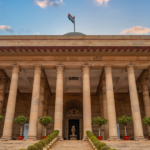
The Supreme Court of India, on a recent Friday, rejected an appeal by Sukhbir Singh Badal, former Deputy Chief Minister of Punjab, seeking to dismiss ongoing criminal defamation charges against him. These charges arose from allegations that he linked Akhand Kirtani Jatha (AKJ), a Sikh religious group, with the banned terrorist organization Babbar Khalsa International (BKI), in the case Sukhbir Singh Badal v. Rajinder Pal Singh.
A bench composed of Justices Dipankar Datta and Sheel Nagu reviewed and dismissed Badal’s plea. Badal, who currently holds the position of President of the Shiromani Akali Dal (SAD), was contesting a defamation suit initiated by Rajinder Pal Singh, an AKJ affiliate. The legal conflict dates back to the 2017 Punjab Assembly election campaign when Arvind Kejriwal, then Chief Minister of Delhi, visited Singh’s home. Badal allegedly commented that Kejriwal’s visit signified his association with radical elements in Punjab.
The crux of Singh’s complaint lies in Badal’s purported statements to the media, which allegedly framed AKJ as the ‘political front’ of BKI and labeled Singh as the spokesperson for the group. Singh contended that these remarks defamed him by suggesting a connection to a prohibited terrorist entity. A magistrate in Chandigarh issued a summons to Badal in the criminal defamation proceedings, prompting Badal to challenge both the defamation complaint and the summoning order in the Punjab and Haryana High Court. After the High Court dismissed his plea in October 2025, Badal escalated the matter to the Supreme Court.
Represented by Senior Advocate Kapil Sibal, Badal argued that the defamation case should not advance. Justice Datta, however, scrutinized the evidence cited in the complaint and challenged Sibal’s assertion that Rajinder Pal Singh lacked the authority to claim spokesperson status for AKJ. Sibal insisted that Badal never explicitly identified Singh as AKJ’s spokesperson.
The bench drew attention to media reports cited in the complaint, where Badal allegedly depicted AKJ as BKI’s ‘political front’ and identified Singh as its spokesperson. Sibal questioned the admissibility of such reports without examining the journalists who authored them, stating, “This is mere reporting. Reporters claim I said something. Your Lordships should not consider this as definitive.” He further argued that Singh was not formally authorized to represent AKJ.

Justice Datta, however, highlighted that the complaint’s evidence itself showed Badal calling Singh AKJ’s spokesperson. “The issue is you recognize him as the spokesperson,” Justice Datta noted before dismissing Badal’s appeal.
The Supreme Court’s decision maintains the progression of the defamation case against Badal, underscoring the judiciary’s stance on balancing freedom of speech with the protection of individual reputations.