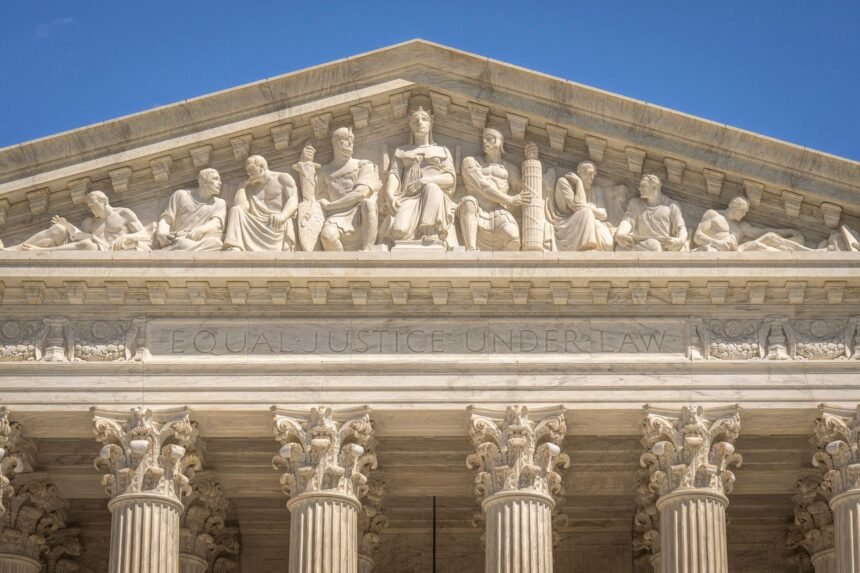
Supreme Court Upholds Madras High Court’s Eviction Order
The Supreme Court has affirmed the eviction orders concerning a 3.93-acre plot belonging to the Arulmigu Annamalainathar Temple in Kadayanallur, Tamil Nadu. This land, over the years, had been developed into residential houses, a mosque, and an Arabic school. The ruling came from a Bench consisting of Justices Aravind Kumar and Vipul Pancholi, who chose not to overturn the Madras High Court’s decision on this long-standing dispute.
Background of the Land Dispute
The contested land forms part of the temple’s extensive property holdings. In 1994, the Tamil Nadu Temple Administration Board initiated a public auction with an upset price of ₹3.10 lakh, which took place on June 19, 1995. The auction saw participation from five individuals, with R Subramanian, the nephew of then-hereditary trustee V Subramaniya Iyer, emerging as the highest bidder with an offer of ₹10.17 lakh.
However, the Madras High Court later identified significant irregularities in the auction process, particularly the post-auction invitation of objections under Section 34 of the Tamil Nadu Hindu Religious and Charitable Endowments Act, 1959. Concerns were raised about the auction’s valuation being markedly below market value, prompting the HR&CE Commissioner to annul the proceedings in 1997. Despite this, the Tamil Nadu government issued a directive in 2002 to uphold the sale.
Subsequent Developments
The land changed hands multiple times, as highlighted by a counter-affidavit from hereditary trustee S Vaidyanathan in prior High Court proceedings. The auction purchaser sold the property to 13 individuals in 2004, who further subdivided and sold it to over 100 buyers. Many constructed residential homes, while a mosque and an Arabic school also emerged on the premises. Court records suggest a predominantly Muslim community inhabits the surrounding streets.
Legal Proceedings and Current Status
The HR&CE Department initiated proceedings under Section 78 of the Act against the land’s occupants. A status report submitted to the High Court identified 83 encroachers, and eviction orders were subsequently issued. Notices served to 81 occupants offered them the choice to become temple tenants or vacate. Ultimately, these occupants agreed to tenancy, leading the HR&CE Department to begin rent fixation and occupation regularization under Section 34A of the Act.
More Read
High Court’s Findings and Supreme Court’s Decision
In December 2025, a Division Bench of Justices Anita Sumanth and N Senthilkumar concluded that the original auction was marred by “gross non-compliance” with statutory obligations and potential collusion with the then-trustee. The High Court emphasized that the temple’s and deity’s interests supersede private interests arising from improperly conducted land sales. With the Supreme Court’s refusal to intervene, the Madras High Court’s decision and subsequent actions regarding the temple land remain intact.
The petitioners were represented by Senior Advocates Huzefa Ahmadi and Sanjay Hegde. The respondents’ legal team included Senior Advocates CS Vaidyanathan, Dama Seshadri Naidu, and V Chitambaresh, along with advocates G Balaji, Niranjan Rajagopalan, Abhinav Parthasarathy, and NC Vishal.