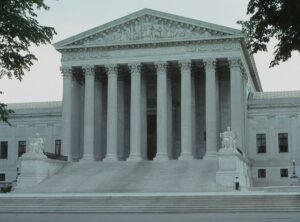
The Supreme Court of India has taken a proactive stance on reforming the nation’s competitive examination processes by seeking a progress report from a task force led by Infosys co-founder Nandan Nilekani. The task force was established to provide recommendations for enhancing and safeguarding the integrity of competitive exams across India.
A bench comprising Justices P.S. Narasimha and Alok Aradhe has mandated the submission of an affidavit detailing the task force’s progress within two weeks. The order specifically directs the Joint Secretary of the Department of Personnel and Training (DoPT), who is coordinating with the High-Powered Committee, to file this affidavit. “We direct the Joint Secretary coordinating with the High-Powered Committee, Joint Secretary, DoPT, who is coordinating with the High-Powered Committee, to file an affidavit indicating the progress made by the Committee. Let the affidavit be filed within another two weeks from today. List after three weeks,” stated the Court.
In a noteworthy move, the Court also expressed its intent to visit the headquarters of the National Testing Agency (NTA) to physically assess the current systems. Justice Narasimha noted, “We will come there one day, myself and my brother,” indicating that they would personally verify the operational efficiency and staffing adequacy at the NTA’s Minto Road location.
Justice Narasimha emphasized the importance of having a robust permanent staff at the NTA, suggesting that half of the employees should not be on deputation from other departments. “There should be permanent staff. Also your relationship with other working institutions, how you are collaborating with them, how much data is… Whether we need statutory backing,” remarked the Court.
Solicitor General Tushar Mehta informed the bench that the Nilekani Committee has been conducting comprehensive consultations and is expected to present a report by the end of September. The Court underscored the necessity of translating the committee’s recommendations into actionable reforms, saying, “Progress is one matter. What are the suggestions made? Most important is institutionalization of it. See, you know what we are a little concerned about. We had the Radhakrishnan Committee. So what we have today is only a committee report. Correct? Full stop. It must progress further. Consideration of the recommendations and its implementation is the most important part.”

The ongoing case involves a series of petitions resulting from recent question paper leaks associated with the National Eligibility cum Entrance Test (NEET). One such petition, filed by the Federation of All India Medical Association (FAIMA) through advocate Tanvi Dubey, calls for restructuring the NTA or replacing it entirely, along with transitioning to a Computer-Based Test (CBT) model and implementing “digital locking” of question papers.
Other petitions include one by United Doctors Front, represented by advocates Ritu Reniwal and Charu Mathur, advocating for the creation of a statutory national testing body with enhanced oversight and accountability to Parliament. Additionally, a separate plea from RJD MP Sudhakar Singh and other public figures seeks the transition of NEET-UG to a CBT format and the establishment of a new independent examination authority.