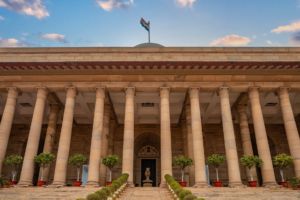
Delhi High Court Decision on Vedanta Oil Block
The Delhi High Court has ruled in favor of the Oil and Natural Gas Corporation Limited (ONGC), facilitating the transfer of assets and operations of a Vedanta-operated oil and gas block located off the coast of Gujarat. This decision stems from the case Vedanta Limited v. Union of India and Others.
Justice Purushaindra Kumar Kaurav dismissed the petition filed by Vedanta Limited, which challenged the Ministry of Petroleum and Natural Gas’s (MoPNG) decision on September 19, 2025. The Ministry had previously denied Vedanta’s application for a ten-year extension of its production sharing contract (PSC) and instructed ONGC to assume control of the block situated in Suvali, Gujarat.
Key Judicial Findings
The court’s earlier directive to maintain the status quo has now been nullified, allowing the government’s takeover directive to proceed. The court determined that Vedanta was ineligible for the extension due to its unilateral deduction of approximately ₹88 crore from the government’s share of profit petroleum to cover its liability for special additional excise duty (SAED).
Justice Kaurav stated, “Ex facie, the said unilateral deduction was not bona fide. The petitioner is handling public resources of the people of India. The scheme of the PSC is such as would require the private company to give the share of the Government.”
Background and Legal Context
The oil block, including the Lakshmi and Gauri gas fields, was initially awarded in 1998 to a consortium involving Cairn Energy, Tata Petrodyne, and ONGC. Vedanta later became the operator, holding a 40% interest, while ONGC holds 50%, and Invenire Petrodyne holds 10%. The original contract expired on June 29, 2023, and Vedanta sought an extension to June 2033. Despite pending approval, the government had provided five interim extensions.
More Read

Financial Disputes and Government Response
In 2022, following the imposition of SAED on petroleum crude, Vedanta attempted to offset the tax against the government’s share of profit petroleum, which the Ministry rejected, citing a breach of the PSC. Vedanta proceeded with the deductions, totaling USD 9.33 million (approximately ₹88 crore), prompting the Directorate General of Hydrocarbons (DGH) to demand repayment with interest.
Vedanta reimbursed the principal amount on September 12, 2025, just days before its extension application was refused, but did so under protest and with intentions for arbitration. The court emphasized that this late payment did not absolve the misconduct or hinder the government from considering it in their decision-making process.
Conclusion of the Case
The court concluded that the government could not be coerced by a private entity’s arbitrary actions. Justice Kaurav remarked that Vedanta had prioritized its benefits over the country’s interests, thereby violating the public trust doctrine derived from the Constitution of India.
More Read

Additionally, the court dismissed Vedanta’s argument that the extension should be automatically approved due to the government’s delay, clarifying that no such automatic extension occurs after the prescribed timelines.
Representing Vedanta were Senior Advocate Jayant K Mehta and a team of legal experts. The Ministry and DGH were represented by Attorney General R Venkataramani and other legal professionals. The Union of India and ONGC were represented by their respective legal teams, including Additional Solicitor General Chetan Sharma.