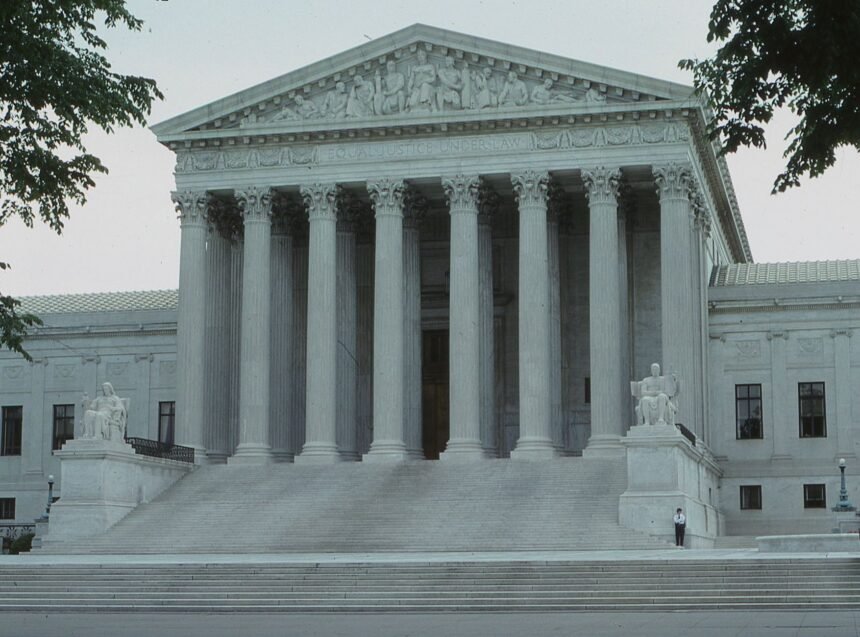
Supreme Court Ruling on Delayed Foreign Travel Tax Deposits
The Supreme Court of India recently provided a significant ruling regarding delayed tax deposits by Saudi Arabian Airlines. On Tuesday, the apex court determined that a delay in depositing Foreign Travel Tax (FTT) collected from international passengers does not equate to an outright failure to pay. Consequently, this delay does not warrant the heavy penalty stipulated under Section 38(3) of the Finance Act, 1979. The ruling was given in the case of M/s Saudi Arabian Airlines v. Union of India and Others.
Details of the Case
The case was heard by a bench comprising Justices JB Pardiwala and Ujjal Bhuyan. They overturned a ₹71.29 lakh penalty that had been imposed on Saudi Arabian Airlines for six instances of delayed FTT deposits between 1994 and 1997. The court found that the taxes were deposited before the issuance of show-cause notices, thus constituting delayed payment as opposed to non-payment.
“Delayed payment of FTT into the Government treasury cannot be equated with non-payment of FTT into the Government treasury,” the court opined. Furthermore, the court emphasized that penalties should not be automatically applied simply because a statutory deadline is missed. The court stated that authorities must examine the reasons provided for any delay to determine if a penalty is warranted.
Understanding the Finance Act, 1979
Under the Finance Act, 1979, and the Foreign Travel Tax Rules, airlines are obligated to collect FTT from passengers traveling internationally and remit it to the Central Government within 30 days of collection. Saudi Arabian Airlines delayed these payments on six different occasions between 1994 and 1997. Delays ranged from one day to 63 days, and in some instances, demand drafts were procured before the due date but could not be deposited due to security constraints. The most extended delay was attributed to an employee’s emergency leave.
Penalty Proceedings and Supreme Court Intervention
Initially, a penalty of ₹12,000 was levied for the six delayed payments. However, upon appeal and fresh examination, the penalty was increased to ₹71.29 lakh under Section 38(3) of the Finance Act. Both the appellate and revisional authorities upheld this heightened penalty, and in 2010, the Bombay High Court also supported this decision, interpreting delayed payment as a failure to pay the tax.

Dissatisfied, Saudi Arabian Airlines approached the Supreme Court. The court clarified that Section 38(3) pertains to non-payment, not to situations where tax is deposited late but before a show-cause notice is issued. The court further explained that delayed payment falls under Section 38(4) when read in conjunction with the Foreign Travel Tax Rules. Rule 4 permits the Collector of Customs to extend the deposit period if a legitimate reason is demonstrated.
Judgment and Implications
The Supreme Court highlighted that the power to impose a penalty also includes the discretion not to impose it. The bench criticized the increase in penalty from ₹12,000 to ₹71.29 lakh, citing the principle of reformatio in peius, which prevents an appellant from being put in a worse position following an appeal. Consequently, the court annulled the ₹71.29 lakh penalty and corresponding orders, directing the government to refund any paid amounts with 9% annual interest within three months.